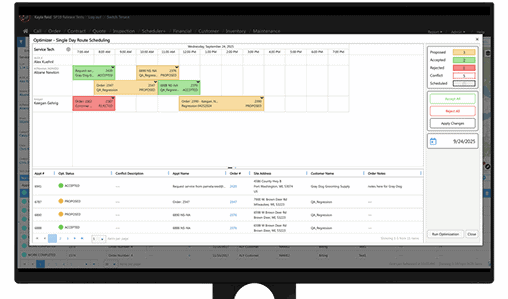
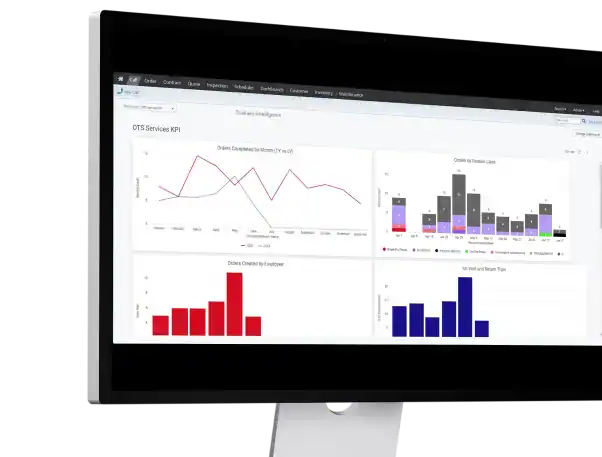
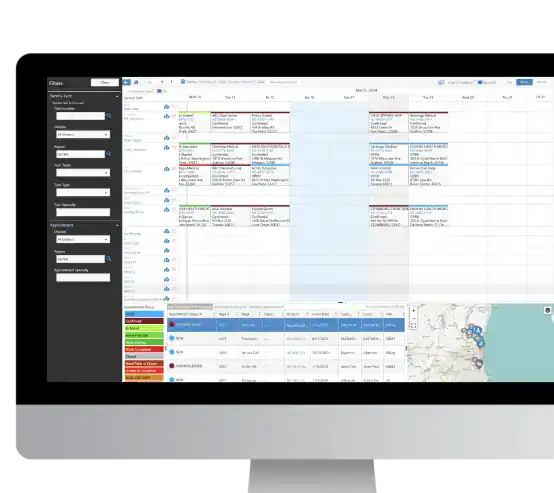
Boost enterprise repair and field service productivity with Service Pro® all-in-one field service management software from MSI Data, proven experts with over 20 years service management experience.
Learn More
Improve Customer Service, Increase Field Service Technician Utilization and Boost Enterprise Service Efficiency with Proven, Cross-Platform Mobile Field Service Software from MSI Data.
Learn More
Increase field inspection productivity, drive inspection consistency and simplify compliance with MSI Data, the experts in mobile inspection software for iPad®, iPhone® and Android®.
Learn More
Drive cable field workforce efficiency with mobile cable software from MSI Data. Whether it's field service, QC inspections, audits or maintenance, our software boosts cable field workforce productivity.
Learn More
Increase the efficiency and effectiveness of your repair centers with the extensive, proven RMA Administration and return service management features of Service Pro® depot repair software.
Learn More
Field service management (FSM), also known as field force automation (FFA), is an attempt to optimize processes and information needed by companies who send technicians or staff "into the field" (or out of the office.) Optimization is difficult, since it involves intelligent scheduling and dispatching of multiple technicians to different locations daily, while minimizing cost and maintaining good customer service. FSM most commonly refers to companies who need to manage installs, service or repairs of systems or equipment.

Field service management involves a combination of some or all of the following: CRM applications, work order management, dispatch, wireless technology, and historical customer service data. Field service software combines many of these functions into one unified solution. The software may also utilize databases containing details on customer premise equipment, access requirements, and parts inventory. Many Field Service Management solutions integrate with other software such as accounting programs like QuickBooks, MYOB, SAP, Mainpac, Oracle, MFGPro etc.
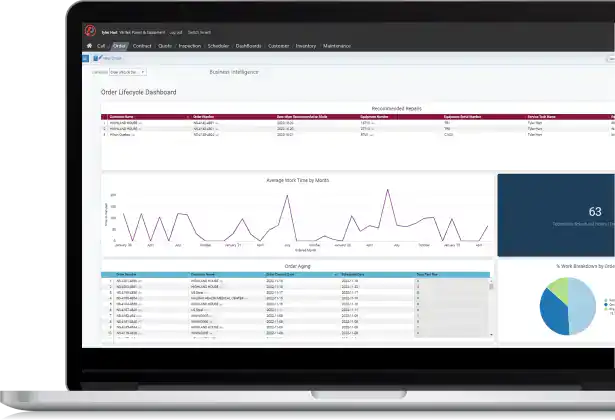
Field service management creates a mobile system that connects the field worker with the backend. In turn, this type of software improves field worker productivity, enhances customer service, automates paper processes, assists with regulatory compliance, reduces human error, inventory turnover etc. In this field power scheduling is often most important because it determines how effective field service management will become. Proper scheduling maximizes work time, minimizes travel time, matches technicians skills and certifications to the work, prioritizes work by service level agreement (SLA), consider the availability of parts, and attempts to avoid technician overtime all while maintaining an acceptable level of customer service.
Read More"In the typical mobile field service scenario, the customer contacts the call center. A call center representative enters a work order. Once the work order is processed, the job notes, billing, and parts information from the order are automatically updated in the systems dispatch and accounting applications. This information is then sent to the relevant field technician's handheld PC, and the technician performs the work. In the case of a problem, the technician can use the handheld device to communicate with the dispatch center directly. The dispatchers thus have real-time, accurate status information about any technician or work order."
The workforce management software market is still immature. According to a study by SRH University of Applied Sciences Heidelberg, workforce management is an increasingly important issue for three-quarters of decision-makers in the top 1,000 companies in Germany – with an upward trend. But only about one-third of these companies actually use an appropriate software solution. Industry analysts such as AMR Research and DMG Consulting forecast that the market for workforce management software will experience dynamic growth.
Workforce management solutions can be deployed enterprise-wide. While special software is commonly used in numerous areas such as ERP (Enterprise Resource Planning), SLM (Service Lifecycle Management), CRM (Customer Relationship Management) and HR (Human Resources) management, the management of the workforce is often still handled by using spreadsheet programs or time recording. This often results in expensive overtime, non-productive idle times, high fluctuation rates, poor customer service and opportunity costs being incurred.
In contrast, by using a software solution for demand-oriented workforce management, planners can optimise staffing by creating schedules that at all times conform as closely as possible to the actual requirement. At the same time, a WFM solution helps users to observe all relevant legislation, local agreements and the contracts of individual employees – including work-life balance guidelines.
A key aspect of workforce management is scheduling. This is achieved by establishing likely demand by analysing historical data (such as the number and duration of customer contacts, sales figures, check-out transactions or orders to be handled). Many workforce management systems also offer manual adjustment capabilities. The calculated forecast values are then converted into actual staffing requirements by means of an algorithm that is adjusted to the particular use case. The algorithm itself is based on the work of Erlang though most modern adaptations of WFM have shifted towards a richer state management, and optimizations to the original idea.
Current and future staffing requirements, short-term peak loads, availabilities, holidays, budget allowances, skills, labour law-related restrictions, as well as wage and contractual terms have to be integrated into the planning process to guarantee optimal staff deployment. In the workforce management process, the integration of employees is an important factor. In several WFM systems, employees can log in their availability or planned absences and they can bid for specific shifts so long as they have the necessary skills for the activities planned for these shifts. Experience shows that professional workforce management systems realistically fulfil more than 80 percent of employees' shift requests. Here, various optimization procedures guarantee the best possible synthesis of optimised staff schedules and employee requests.
The more flexible the working time models and the more complex the staff scheduling becomes, the higher the requirements for correct time management becomes. As time recording and accounting of working times are closely connected to scheduling, the integration of time management into the entire process is the logical consequence. Using workforce management systems, working times are booked exactly to the required time accounts and made available for payroll accounting by means of automated processes.
Many software solutions offer a number of options for evaluating the planning in real-time, enabling short-term reactions to deviations from the forecasted demand or expected over- or understaffing. Control functions enable a permanent adaptation of the scheduled staff to the actual requirements. In other words, the optimization process allows for manual data adjustment in the case of short-term fluctuations in demand or unscheduled employee absences.
Workforce management is itself evolving into a solution termed workforce optimization. This builds on workforce management to encompass all aspects of managing the complete workforce lifecycle and supports the business with key insights into how its workforce is performing. There is an emphasis not simply on improving operational efficiency or on managing the workforce effectively, but tieing this to key business concepts such as the customer experience. The role of workforce optimization is to tie together siloed systems and bridge between the three main stakeholders of HR, operations and IT. This approach is business driven. It involves automating entire processes, making key data more visible to support better decision-making, ensuring compliance with a wide range of relevant legislation and solving business problems related to staff. Workforce optimization is best viewed as the next logical step in the move to optimise the performance of staff and to manage and understand the impacts of staff on both operational efficiency and the customer experience.
Workforce Management provides a common set of performance-based tools to support corporate management, frontline supervisors, store managers and workers across manufacturing, distribution, transportation, and retail operations. The starting point is a clear definition of the work required through engineered standards and optimal methods for performing each task as efficiently and safely as possible. Based on this foundation and demand-based forecasts, workers are scheduled, tasks assigned, performance is measured, feedback is provided and incentives are computed and paid. In addition, online training is provided along with supervisor-based coaching to bring all workers up to required levels of proficiency. It's a complete approach designed to make your workforce as productive as possible, reduce labor costs, and improve customer service.
Field Force Automation refers to the use of technology to capture field sales (or service) information in real time. This involves use of technology, typically handheld PDAs, wireless devices or mobile phones to capture data. The captured data is transferred immediately to back end systems (ERP, CRM or accounting systems) through Wifi, 3G or GPRS connection. This instant capture of information reduces time delays, avoids manual data errors and enhances field force productivity. From an operations perspective, availability of field information in near real time allows to plan delivery schedules, reduce inventory and monitor & control the field sales team. The biggest challenge in Field Force Automation is in developing a simple, but usable, user interface for the hand held device/ mobile and connectivity at the location of information capture. Connectivity can be overcome by having a system which can retain the information captured in the device cache and later synchronize with back end systems.
Replicated from www.wikipedia.org under the Creative Commons Attribution-ShareAlike License.
Collapse